
|
By Pravin Jeyaraj The industry sectors with some of the worst compliance with National Minimum Wage (NMW) legislation are also the ones with relatively high numbers of staff on zero hours contracts. The Department for Business, Energy and Industrial Strategy (BEIS) have released data on 208 employers who failed to comply with the law and pay staff the National Minimum Wage (NMW). According to the data, of the 208 employers, 45 were in the hospitality sector, 36 were in the retail sector and 14 were in the domicilary care and childcare sector. 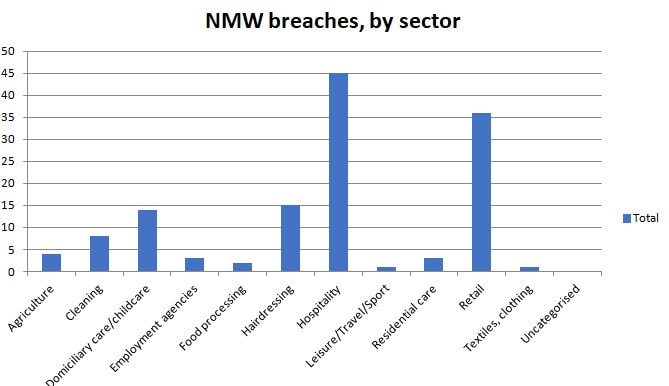 Source: BEIS Chart created by Zero Hours Justice According to recent data from the Office for National Statistics, there are almost 1 million workers on zero hours contracts and 24.9% are in the accommodation and food sector, 11.6% are in the wholesale and retail sector and 19.4% are in health and social care. 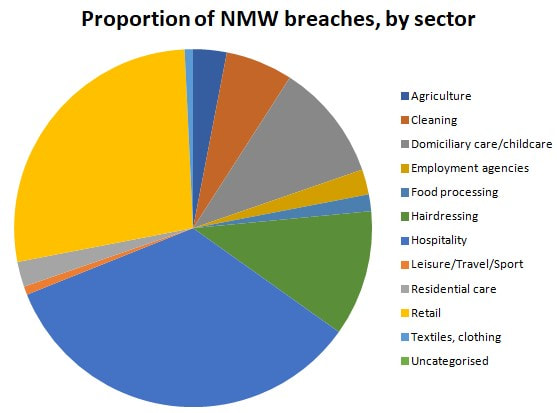 Source: BEIS Chart created by Zero Hours Justice The various employers named and shamed by BEIS range from multinational companies to sole traders and they breached national minimum wage legislation in a number of ways. Whilst not all breaches were intentional, the main reasons for employers' non-compliance were the practice of making workers pay for the cost of uniforms or complying with a dress code (37%) and unpaid working time such as mandatory training, trial shifts or travel time (29%). For workers earning the NMW, these practices effectively takes their pay below that level. It was also found that 16% of the 209 employers did not pay the correct minimum wage rate to apprentices and 11% failed to increase NMW pay whenever the rate rose or paid the wrong rate. Whilst zero hours workers are also entitled to receive at least the NMW, the types of deductions or errors that are made to reduce the NMW rate can exarcebate the financial insecurity faced by those who cannot rely on guaranteed hours of work.  House of Fraser, which recently moved staff to zero hours contracts, was found to have failed to pay £16,235.19 to 354 workers. If you are on a zero hours contract and are concered that you are not receiving at least the minimum wage, please check the government's "Check Your Pay" website or contact your trade union or Zero Hours Justice for advice and assistance.
By Pravin Jeyaraj  Kristian Fuzi, a PhD student at the University of Mancester, is interested in speaking to workers on zero hours contracts as part of study into how their working arrangement has affected their finances during the pandemic. He is looking to hear from zero hours workers in all sectors, particularly individuals aged 30-50 who are earning roughly between £12,000 and £20,000 per year and living in the North West of England. The focus of his research is in understanding how people in various forms of previous work, including zero hours contract and self-employment, manage their financial situation witout employer benefits, such as full-time hours, sick pay, maternity pay and pensions. Kristian believes that precarious work creates an higher level of personal or financial risk, compared to those in permanent employment. To find out more or to take part in an online Zoom or Skype interview, please contact Kris Fuzi: kristian.fuzi@postgrad.manchester.ac.uk.
By Pravin Jeyaraj The Chartered Institute for Personnel and Development (CIPD) has released their own data analysis, from which it has concluded that employment in general is becoming more secure, with only "pockets of insecurity". According to the CIPD's analysis, the proportion of people working on variable hours, working part-time involuntarily or want to work more hours has fallen since 2010. However, according to the latest figures from the Office for National Statistics (ONS), the proportion of people in employment who are zero hours contracts has actually increased from 0.6% for the period October to December 2010 to 3.1% for the period July to September 2021. Whilst we accept that this is statistically a small proportion of people in employment, it still amounts to almost one million people on zero hours contracts. 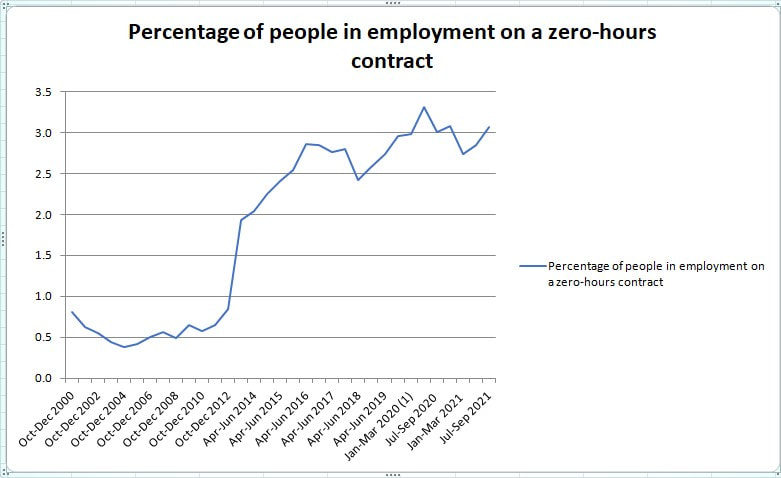 Source: Office for National Statistics Whilst the majority of people on zero hours contracts have told the ONS that they do not want to do more hours, there are still almost a quarter (23%) who say they are underemployed and either want an extra job (3.1%), another job with longer hours (5.2%) or more hours in their current job (15.1%). We are not opposed to zero hours contracts, where people have the choice between that and a different type of working arrangement. However, just because the majority of zero hours workers say they do not want more hours, that does not mean that employers are using zero hours contracts appropriately. According to the ONS, more than a third (33.7%) of people on zero hours contracts say that they work full-time hours and, for those in one job on a zero hours contract, the average number of hours per week is 25.5. The whole argument put forward in favour of zero hours contracts is that it allows employers to match staffing levels to fluctuating business demand. If there is enough work for someone to be working on a full-time basis or for a weekly average number of hours that amounts to part-time work, we would question why that person needs to be on a zero hours contract. There is clearly enough work to warrant giving them an a permanent or fixed term employment contract. Our view is that employers should regularly monitor hours actually worked and, where a regular working pattern develops, they should offer a fixed or guaranteed hours arrangement. The CIPD also found that 64.5% of people on zero hours contracts are actually in permanent employment, so they should have full employment rights, subject to continuity of service. In theory, that is correct. The problem is that continuity of service depends on there being no periods of non-work of at least a week. So, it is quite possible for someone to be employed with an employer for two years or more, but the number of weeks they have actually worked - apart from annual leave and sick leave - does not amount to two years. The use of zero hours contracts may be relativey low, compared to more secure working arrangements, but the "pockets of insecurity" identified by the CIPD are still quite deep.
By Pravin Jeyaraj  There are now more people on zero hours contracts in the United Kingdom than there were before the beginning of the Covid 19 pandemic in March 2020, according to the Office for National Statistics (ONS) In the latest Labour Force Survey, 996,000 people told the ONS that they are on zero hours contracts during the period July to Septemer 2021, compared to 985,000 people for the period January to March 2020. It's not quite as high as the peak during the first lockdown, when the number of zero hours contracts broke through the one million mark. But, with employment going up, despite the ending of the furlough scheme, it quite likely to reach that level by next year. 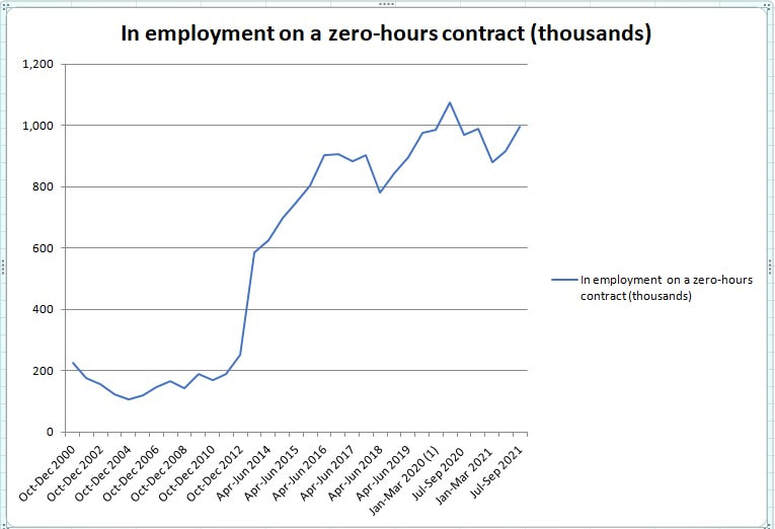 Source: Office for National Statistics The data indicates that many people are not happy to be on zero hours contracts, with 14% looking for either a new job or extra work, compared to 4.3% of those who are not on zero hours contracts. A big factor of this dissatisfaction has to be the lack of work - and thus lack of income - available on a zero hours contract, with almost a quarter (23.4%) saying they are underemployed, compared to 6.5% of people who are not on zero hours contracts.
Source: Office for National Statistics Over a third (36.4%) of people on zero hours contracts have been with their employer for just 12 months of less, with 25.9% staying with their employer for two to five years, 16.4% staying between 1 and 2 years and 21% staying for longer than five years. People on zero hours contracts are, statistically, more likely to be foreign origin. When looking at nationality, 3.8% of non-UK nationals are employed on a zero hours contract, compared to 3% of UK nationals. When looking at country of birth, 4% of those born outside the UK are employed on zero hours contracts, compared to 2.8% of those born in the UK.
By Pravin Jeyaraj The maximum pay increase that the average worker on zero hours contract, earning the National Minimum Wage (NMW), is likely to see from April 2022 is just £20 a week, according to an analysis of government data by Zero Hours Justice. Rishi Sunak, the Chancellor to the Exchequer, announced in the Budget that the National Living Wage (the top rate for the NMW for those aged 23 and over) would be increased by 6.6% from £8.91 to £9.50. Much has been made of the fact that this amounts to an increase of just 60p an hour. Whilst any pay rise is good, this is quite pitiful for anyone earning the NMW. The situation is recognised as been even worse for those on zero hours contracts, who do not have guaranteed hours - or even guaranteed work - each week and so whose income will vary from week to week. 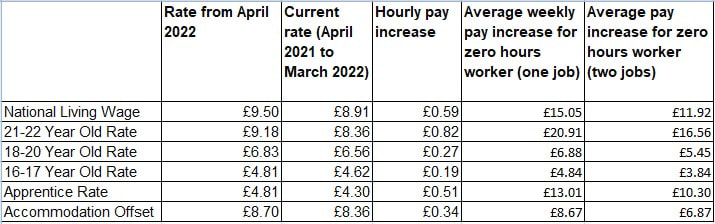 Analysis by Zero Hours Justice According to the latest data from the the Office for National Statistics, a zero hours contract worker, doing only job, works an average for 25.5 hours. The data also shows that a zero hours contract worker doing two jobs works an average of 20.2 hours. This means that, following the 6.6% increase in the National Living Wage, a zero hours contract worker, aged 23 and over, doing one job and earning the minimum wage, could see an average pay increase of just £15.05 per week. If the worker is aged 23 and over and doing two jobs, both on zero hours contracts and the minimum wage, they are likely to see an average pay increase of just £11.92 a week. The biggest benefit will be seen zero hours contract workers aged 21-22, with an average weekly pay increase of just £20.91 If a zero hours worker has been topping up their low wages with Universal Credit, then the rise in the minimum wage is, in most case, not even enough to offset the ending of the £20 uplift. The increase does not kick in until April 2022 so, with the recent rise in National Insurance and with inflation going as high as 4% by the end of the year, workers would arguably be worse off in the mean time and any forthcoming pay rise could easily be swallowed up. But, of course, all this depends on whether a worker on a zero hours contracts is able to be offered around 25 hours a week on a regular basis. The reality is, whatever their working pattern, a zero hours worker cannot be certain of how much work they will have from week to week. And, despite government assurances to contrary, we cannot be certain that there won't be another lockdown as the NHS comes under pressure - thereby leading to the loss of even regular work. What would help zero hours workers even more would be a legal or contractual right to a fixed hours contract and the obligation on employers to regularly review hours worked and more workers to fixed hours contracts. At the same time, with the unpredictability of hours, it would we believe that employers should provide at least two weeks' notice of shifts and still pay if shifts are cancelled at less than two weeks notice.
Almost 25% of all jobs in adult social care (380,000) employed on zero hours contracts, with care workers making up the highest proportion (35%). Those in management positions made up just 6% of staff on zero hours contracts, indicating that it is the junior staff who are more likely to be disadvantaged by job insecurity. 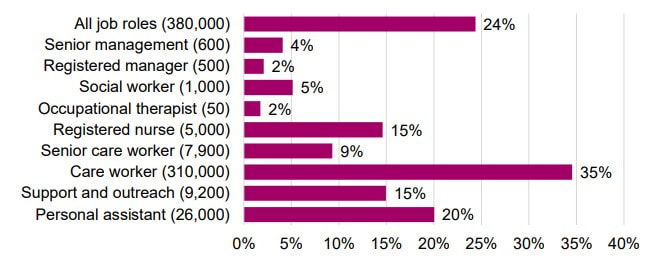 Estimated number and proportion of workers in the adult social care sector on a zero-hours contract, by selected job roles, 2020/21 Source: Skills for Care Across all job roles, most zero hours contracts are concentrated in domiciliary care, followed by community care. Amongst care workers, 55% of those on zero hours contracts are in domicilary care, compared to 26% in community care. 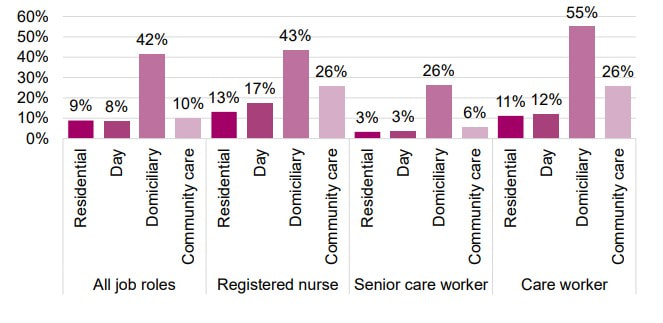 . Estimated proportion of workers in the adult social care sector on a zerohours contract, by care setting and selected job roles, 2020/21 Source: Skills for Care By Pravin Jeyaraj Staff on zero hours contracts in the care sector were significantly more likely to leave their jobs, compared to staff with more contracted hours, according to research from Skills for Care. In the report, "The State of the the Adult Social Care Sector and Workfore 2021", the charity found that the turnover rate for staff on zero hours contracts was 32.1%, compared to a turnover rate of 21.3% for full-time workers (more than 35 hours). 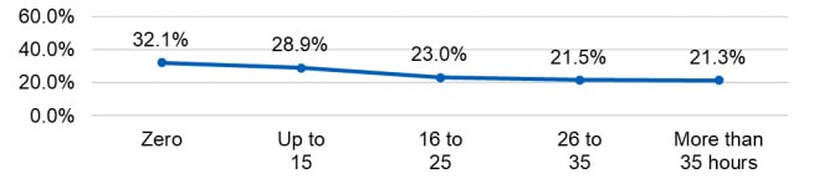 Care worker turnover rate by contracted hours Source: Adult Social Care Workforce Dataset - unweighted data between March 2020 and March 2021 For those specifically working for residential care providers, the difference was even more stark, compared to domiciliary care workers. The turnover rate for zero hours workers was 37.5%, compared to 23.5% for those not on zero hours contracts. 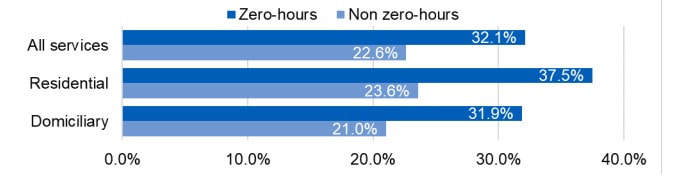 Care worker turnover rate by zero hours contract status Source: Adult Social Care Workforce Dataset - unweighted data between March 2020 and March 2021 Around 410,000 people have left the social care sector as a whole, a turnover rate of 28.5%. But for registered nurses in the sector, the turnover rate stands at 38.2%, compared to 8.8% for nurses in the NHS.
by Pravin Jeyaraj
If you would like to participate, please contact Konrad Wakolbinger on konrad_wakolbinger@yahoo.de. More information about the project can be downloaded below: 
By Chris Peace
Whenever the government is asked to ban or better regulate the use of zero hours contracts, the answer is also the same – that they offer flexibility to both employer and employee. For a very small number of workers, who have other means of financial support, this may be true. However, for most workers, where their zero hours contract is their only means of income, it is simply not the case and this false narrative of “mutual benefit” needs calling out.
Even before the pandemic, low wages were not enough for many to keep up with their cost of living, energy bills, travel, rent and food costs. To get by could be a stretch. Imagine not knowing if your basic weekly or monthly costs could be met, simply because your employer could not give you enough hours of work. Imagine making and committing to childcare costs or making arrangements for care for relatives so you could work, only to be sent home early because “business is quiet” or to be told hours before your shift is due to start that it has been cancelled. Imagine being asked to work longer hours at short notice and risk getting on the wrong side of your boss if you refused. The financial instability created by being on a zero hours contract does not simply result in the worry and reality of impoverishment. It also impacts on basics like renting a home, which is nigh on impossible in the private sector when a stable income cannot be demonstrated to a landlord. The pressure this puts on such workers and their families manifests in anxiety and stress, poor mental and physical health and general misery and unhappiness. Ultimately, zero hours contracts may result in better profit margins for the bosses, but at a potential cost to the public purse. At Zero Hours Justice, we know that banning zero hours contracts is going to need political will. Whilst some political parties have been calling for them to be banned for some time, the current government shows no signs of doing so. We will continue to press for this, alongside the trade union movement, after all we are one of a minority of countries in Europe that hasn’t banned or restricted their use. They are now banned in Ireland in almost all circumstances and completely banned in New Zealand. However, until such change can come from government, the Zero Hours Justice campaign is dedicated to doing all we can to improve and restrict their use to try to bring some improvement to the lives of zero hours workers. To this effect we have developed our Fairer Hours Contracts standard and seek to persuade employers to adopt it. This would mean workers get a minimum of two weeks’ notice of their shift, and shifts cancelled at less than 2 weeks’ notice would still be paid in full. Fairer Hours accreditation also requires employers to give zero hours workers the right to request a fixed hours contract at any time as well as an annual review of actual hours worked with a view to providing a contract at or as close to the hours as soon as they can. Good employers can lead the way in addressing what the government has yet failed to do by adopting our proposals. More importantly, the lives of hundreds and thousands of workers would be improved. Zero hours justice backs labour's plans to end the "one-sided flexibility" of zero hours contracts29/7/2021
By Pravin Jeyaraj
In theory, for example, a zero hours worker could do twenty hours in one week and no work the next week. In addition, employers are not required to give notice either of available work or cancelled shifts. According to research from the Living Wage Foundation, almost 40% of zero hours workers given less than a week's notice before shifts. Some even turn up for their shifts, expecting to work, only to be told that they are not needed and not being paid. With such job and income insecurity, it can be difficult to plan your finances, especially when you do not know whether you will be able to pay your bills and feed your family from month to month. It surely cannot be right that the only way people can afford to live is by having their low, irregular pay topped by benefits. It can also be hard to make alternative arrangements for childcare or other caring responsibilities when work does become available at short notice. The irony is that many zero hours workers actually do work regular hours, or a regular number of hours, without really knowing whether they will still have work the next day or the next week. We saw this during the pandemic, with people suddenly finding themselves without work and pay. Zero Hours Justice therefore supports Labour's pledge to end "one-sided flexibility so all workers have stable, secure employment and mutually-agreed predictable working hours and shift patterns so they can plan their lives". However, zero hours workers cannot wait until at least 2024 and a change in government. We therefore urge the Conservative government to fulfil its manifesto commitment and publish its employment bill, with a right to a more predictable contract for zero hours and variable hours workers.
|
contactFor press enquiries or permission to reuse content, please contact: Archives
January 2024
CATEGORIES
All
|
||||||||||||||||||||



 RSS Feed

|
Company No: 12417909 Registered Office: 38 Coney Street, York, Y01 9ND
|